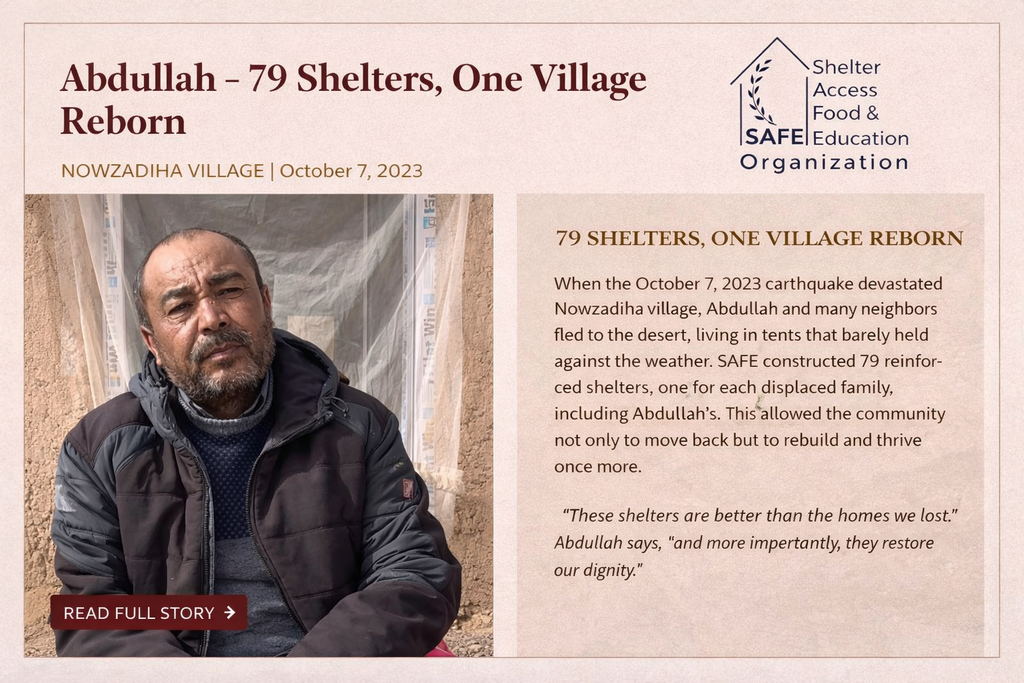
Before the earthquake, Abdullah, a 52-year-old father of seven, was already living on the edge of hardship in Nowzadiha village. Like many families in rural Afghanistan, his household depended on seasonal agricultural labor — enough to survive, but never enough to prepare for disaster.
When the earthquake struck on October 7, 2023, it destroyed everything. Homes collapsed, livelihoods vanished, and the community was left with nothing but rubble and uncertainty. With no resources to rebuild, Abdullah and his neighbors faced an impossible decision: remain among the ruins or abandon their village entirely.
Many families fled to the nearby desert, setting up makeshift camps with whatever materials they could find. Aid organizations provided tents, blankets, and hygiene kits, offering immediate support. But the brutal climate soon exposed the limits of emergency assistance.
Rain flooded the tents. The sun turned them into ovens. Winds ripped through them without warning.
“We survived the earthquake,” Abdullah recalls, “but every day afterward, we were fighting the elements just to stay alive.”
The community reached out to SAFE, seeking not only relief, but a lasting solution. SAFE conducted rapid assessments and prioritized resilience alongside humanitarian response. Within weeks, SAFE constructed 79 durable transitional shelters — one for every displaced family in Nowzadiha village.
Abdullah’s family received a shelter with secure walls, dry flooring, protected living space, and room for his children to study and sleep safely. For the first time since the disaster, they could lock their door, store food, and regain a sense of normal life.
The impact extended beyond individual households. Families returned from the desert. Neighbors gathered again. Children played without constant dust and fear. Abdullah even planted a small vegetable patch beside his shelter — something unimaginable while living under a fragile tent.
“These shelters are stronger than what we had before,” Abdullah says with quiet conviction. “One shelter is worth more than ten tents — but more importantly, it restores dignity.”
The construction of 79 shelters did more than provide housing. It revived an entire community’s belief that safety is not a privilege, but a right — and that recovery is possible, even after devastating loss.